Earlier this morning, around 8am I took this shot of the sky over Hastings on Hudson. The clouds were in long fat rolls of different shades. There was little wind. We expect this to be an eventful day, and we are concerned with the outcome. But, right now, it is beautiful and quiet outside, but dark and ominous.
It is now 3:09 in the afternoon and half the sky is bright and shiny; half the sky is grey and rainy. The winds are gusty and coming in the opposite direction from usual. Trees are swaying.
We took precautions, as advised by our governor and our mayor of NYC. We left Connecticut early in order to get back to New York to prepare the house for the storm. This morning we prepared vegetarian meals to get us through a loss of electricity that is expected. We have filled up containers with water, cleared off the decks, and are now sitting tight.
The worst thing to do now is to peek at the news to see what is coming. It doesn't look good. The alarms just went off in our village. I have seen photos showing flooding by the river into our local parks. Most of us are a bit nervous and concerned, but at this point there is little we can do beyond watch it happen. I worry about the size of the damage that is about to be done. Such a large area is affected by this storm.
My husband's flight to California on Wednesday was just canceled. The subways system, and all public transport in the city and areas surrounding it are stopped. The buildings in south Manhattan where our son works are evacuated. Wall Street is silent. This is not a happy day.
Monday, October 29, 2012
Saturday, August 25, 2012
Potholes can be pretty
According to a guerrilla group of gardeners who are gardening on public lands, a garden can be so small that it fits in a pothole, a purse or a shoe. Pothole Gardening: An Example What a playful idea this is.
Monday, August 13, 2012
Learning to Live in Small Spaces
We seek ways to make our transition easier as we move from a big home to a smaller one. A site that is very helpful to me is the Tiny House Blog . This blog draws attention to the many ways in which living in a small space can be both challenging and fun.
I can vouch for one thing already. Downsizing to a smaller home is invigorating. It provides lots of exercise just running up and down the stairs, for example, carrying mattresses, blankets, sleeping bags, boxes of old toys. And then there are all the pieces of furniture to move around, like dressers and couches, old cots and tons of books.
Recycling is a very popular activity. Yesterday, we put a sign sign saying "Free" on some items we put out in the front yard, next to the front road. It included a large chair and ottoman, barbells and weights, and a lamp. Much to our pleasure and surprise, they were all gone in a matter of a few hours. It feels like a miracle to put items no longer wanted or used outside and watch them usefully disappear.
I can vouch for one thing already. Downsizing to a smaller home is invigorating. It provides lots of exercise just running up and down the stairs, for example, carrying mattresses, blankets, sleeping bags, boxes of old toys. And then there are all the pieces of furniture to move around, like dressers and couches, old cots and tons of books.
Recycling is a very popular activity. Yesterday, we put a sign sign saying "Free" on some items we put out in the front yard, next to the front road. It included a large chair and ottoman, barbells and weights, and a lamp. Much to our pleasure and surprise, they were all gone in a matter of a few hours. It feels like a miracle to put items no longer wanted or used outside and watch them usefully disappear.
Sunday, July 15, 2012
Leaving Home and Garden
It is not easy to leave our home and garden after thirty years.
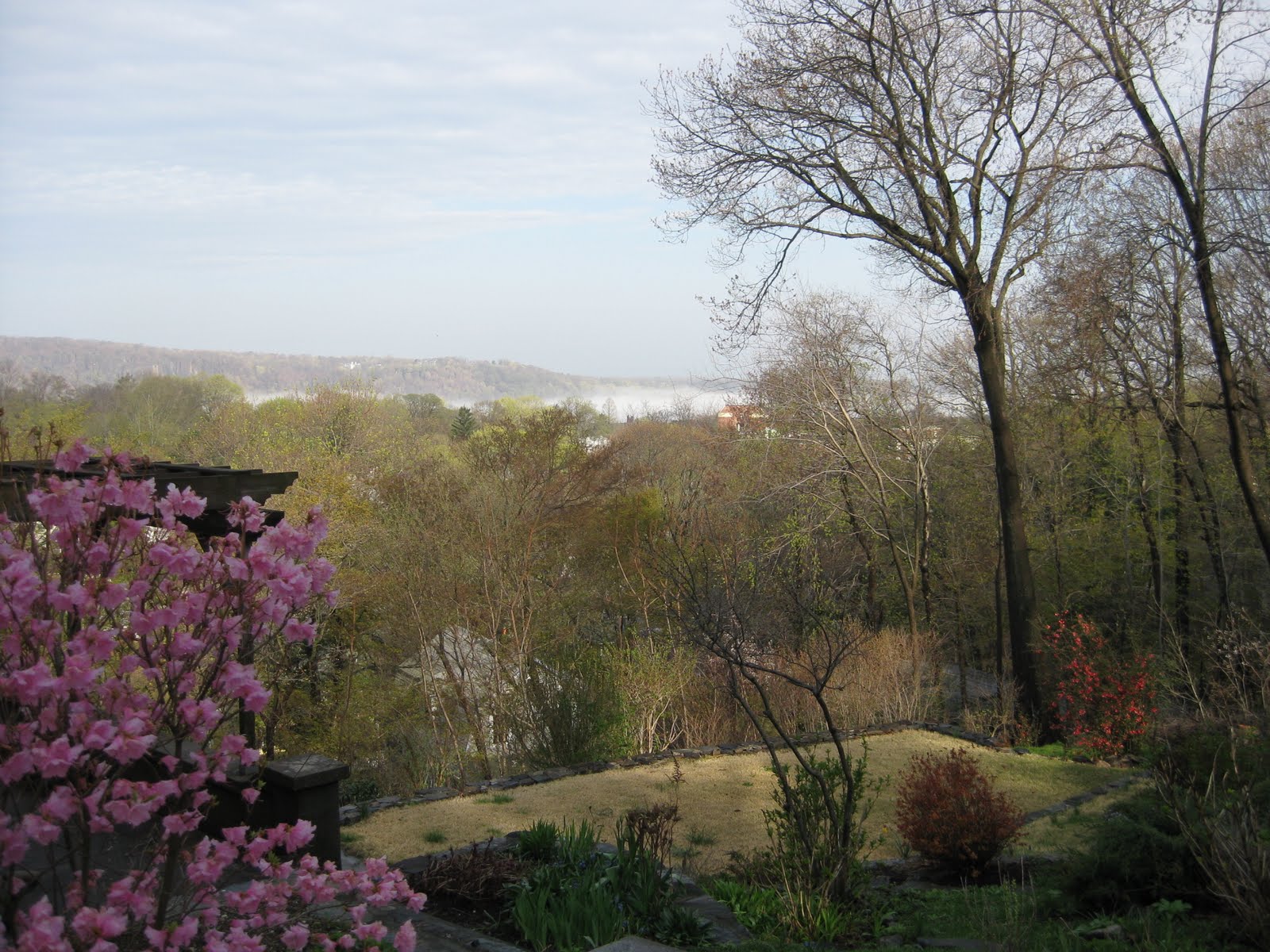
Our home is located in the Hudson Valley and our garden is on a long and steep slope that eventually ends up at the Hudson River, facing the Palisades. When we walk to the train station to go to the city for work, we walk 0.7 miles straight down the steep slope to the river, using a sidewalk, of course, and not by rappelling in our backyard.
Our
garden is a small tamed area sitting on a slope in rather wild and natural surroundings. It is a place to enjoy for all seasons and has a character all its own in
spring, summer, fall and winter. For as long as we have lived here, we have worked on taming it, just a bit.
When we sell our home, we leave the garden behind, but we will take our gardening ideas to our next location and will design and experiment in a new context. We have several principles that we use in our garden that will no doubt apply to the next:
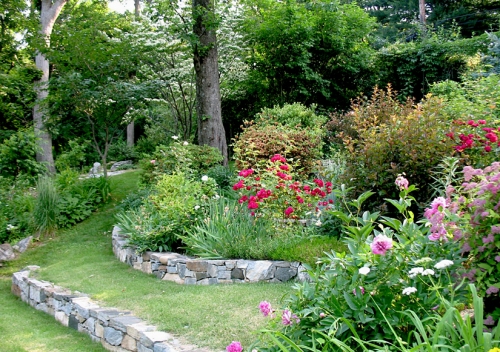
We practically have no lawn on our property. What lawn that we do have is set on a terrace and is surrounded by flowers and bushes that mingle and match in their own ways. As the years have moved along it has become quite unpredictable what flowers we will find in the spring that have settled into our lawn.


The north deck overlooks the small lawn and peers out into the terraced garden. The deck is low and faces the Palisades. We have spent many a summer dining out here on this deck with the children.
The south deck overlooks the Palisades and the Hudson River and sits much higher.
In any season, this deck is a great spot to watch the sun set.

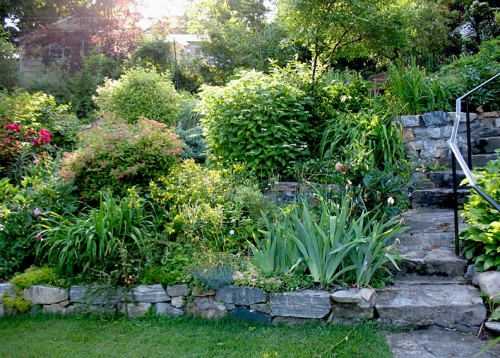
Our garden is sloped and terraced.

There are stairs to help us get from one level to the other.

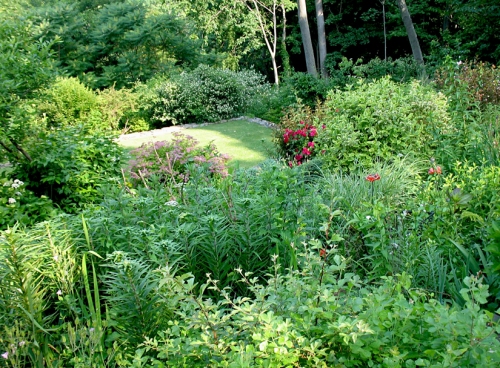
The garden shifts from tame to wild as it heads toward the woods.
We get an interesting perspective on our garden from our attic window.

The circle of bricks surrounding the bird bath out front was built by my husband as a gift to me, some ten years ago.
The plants that we have put in in the garden are not treated in any way with chemicals. These
roses are neither fertilized nor treated with chemicals, nor are they watered regularly. Yet, for thirty
years, they have grown multiplied and thrived on the slope. At the top of
the garden slope, we compost leaves, all our cuttings and vegetable
scraps from our kitchen. The result has been wonderful.
In the autumn, the Palisades are in full view from the North Deck, as is the Hudson River, from the South Deck.
THere
is a patch of flowers left as a gift for me in the middle of the lawn by my son when he
went to college.
| View from South Deck |
| Backyard |
When we sell our home, we leave the garden behind, but we will take our gardening ideas to our next location and will design and experiment in a new context. We have several principles that we use in our garden that will no doubt apply to the next:
- The fun never stops;
- Our legs and back always ache and we are on our knees a lot; and
- If you water the lawn very heavily, it will rain.
We practically have no lawn on our property. What lawn that we do have is set on a terrace and is surrounded by flowers and bushes that mingle and match in their own ways. As the years have moved along it has become quite unpredictable what flowers we will find in the spring that have settled into our lawn.


![]() |
| Our North Deck in Summer |
The north deck overlooks the small lawn and peers out into the terraced garden. The deck is low and faces the Palisades. We have spent many a summer dining out here on this deck with the children.
| North Deck in Spring |
| South Deck in Winter |
The south deck overlooks the Palisades and the Hudson River and sits much higher.
| South Deck in Summer |

Our garden is sloped and terraced.

There are stairs to help us get from one level to the other.

The garden shifts from tame to wild as it heads toward the woods.
We get an interesting perspective on our garden from our attic window.

In the autumn, the Palisades are in full view from the North Deck, as is the Hudson River, from the South Deck.
He mowed around them and said to me, "Here Mom, a
present, something to remember me by." Fifteen years later, in the
spring, they are still popping up in the center of the lawn.
It makes
me smile.
Saturday, July 14, 2012
Fixing Up the Old Cottage
If there is an interested buyer who is on a diet, I might add that one asset of this refrigerator is that it takes two hands (and sometimes two people) to get the door open and if you are a little kid at least one foot as well. This reduces the amount of time spent snacking on unnecessary food items and it is also good exercise for people who need their arms (and perhaps their legs) strengthened.
If we get depressed from looking at this heap of rubble, all we do is go around the front of the cottage and look at the lake instead. It reminds us why we are doing this.
Wednesday, June 27, 2012
Downsizing: What does it mean?
Our footprint is too big! We are holding down the fort on a five bedroom, three bathroom home. We kept the children's three bedrooms as they left them, expecting that they might come back.
For the first decade after all our kids left for college, they did come and go,dropping off more stuff in their rooms with each visit. They came home for the summer break, and between summer internships, left for graduate school, came home for weekends and vacations, showed up for short-term jobs, and eventually got their own apartments, leaving more items at home, in their room, and in the basement. They left behind their childhood books and toys, school books, skis, sweaters, jackets, gloves, boots, sleeping bags, posters,old correspondence, lecture notes,records,CD's, and the list goes on.
Then came our second decade after our children graduated from high school and left for college. All three or our adult children acquired their own homes or apartments and are busy with careers and jobs, their own families and friends. We are very happy that they are all independent. They are now making their own collections of furniture, books and children's toys. We can visit them and read their books, sit on their furniture and play with their kid's toys!
We are about to go into our third decade since our eldest child left for college. We see the need to downsize our home to fit our current needs. We are two people with a large network of family and friends. Our children and friends visit, but they don't live with us except for very short periods of time. As of this year, we are both retired.
We have always had plans, goals, and things to do. We don't expect that this will change. We are making plans for this upcoming decade. One big plan is to have a smaller footprint.
We have a habit of sipping a cup of coffee in the morning while still sitting in bed, and talking things over. The other day, we decided to list our current downsizing goals. Here they are.
- Have what we need;
- Need and use what we have;
- Live simply and respect the environment;
- Keep a place to hang our hat and call home and welcome others into it;
- Eat nutritious food, sleep well and get regular exercise;
- Enjoy good friends and meet some new ones;
- Continue learning and develop new skills;
- Be available to our children, grandchildren, family and friends;
- Contribute to our community;
- Be appreciative and thankful for what we have and show our gratitude.
| 1960's renovated home |
| Our children and grandchilddren at the beach |
| Storm damage |
As a third step in this direction we are reconstructing a tiny lake cottage that we have owned and used for 20 years as a hide away and camping site. We are taking our 500 square foot lake cottage with a 200 square foot guest cottage and reconstructing it so that we can live in it more effectively. The cottage is seasonal, small, charming, and outdated. Our refrigerator is fully functioning and 60 years old (American made, I might add) ; the cottage walls are crumbling, the floors are tired and after two trees fell on our bedroom during a summer storm, it is well-ventilated It is a 1940 seasonal wooden cabin that was last renovated in 1950. For years, I have called it "our little wooden tent". It has a great stone fireplace and terrific access to the lake. But it needs to be brought up-to-date, and the holes in the walls sealed to keep out extra critters who visit without invitations.
We just started working on the renovation. When we are through with the renovation, it will continue to be a 500 square foot cottage with a 200 square foot guest cottage and it will still be seasonal. It will be small, charming, and hopefully, up-to-date. We are renewing the appliances, strengthening the walls, and preparing it to house us in the spring, summer and autumn.
When we are done with the renovation, I plan to stop calling it "our little wooden tent" and will hopefully call it instead, "our little renovated wooden tent".
It sounds easy to make a simple plan like this. But, of course, it gets complicated. In all fairness, we started to downsize several years ago when we found the home to renovate in the Bahamas and chose to live in a t-shirt and shorts for most of the winter. We have now figured out where we will live in spring, summer and autumn, which includes selling our home of thirty years and setting up our new living arrangements for summertime at the cottage. One of our goals is to not own a furnace. We are almost there.
In the process of getting ready to sell our home, we have some big steps to take.
First, we have to get busy and sell things, give things away, recycle the rest and put as little as possible in the garbage. We don't want to downsize by filling up the dump. That defeats our purpose.
Second, we must store items that might be useful for living in a year-round condominium at a future date and also keep certain items for our children in case they want or need them in the years to come.
Third, we will put our estate plans in order, all papers accounted for, and everything set up for easy transference if something happens to us. And we have to locate the papers in a place where they are readily accessible and kept up to date.
Fourth, we will expect the unexpected. Without a doubt, there are all the things that we didn't yet think about, but will realize that we should have done. And there are all the unexpected outcomes of our current decisions that we haven't yet experienced and don't yet realize the implications.
It could get complicated, but we hope not. After all, this is a blog about simple living for complicated people. How complicated can it get?
Sunday, April 15, 2012
Woodturning in Bahama Palm Shores
| Steve Knowles |
I often stop by to see what Steve is making. Our out of town guests ask whether they might visit Steve's workshop and see what he is turning out. They like to take Bahamian arts and crafts home with them.
Steve works with wood from a number of native trees including mahogany (Swietenia mahogany), mahoe (Hibiscus tiliaceus L. Malvaceae), tamerind (Tamarindus indica), red cedar (Juniperus bermudiana) and poison wood (Metopium toxiferum), among others.
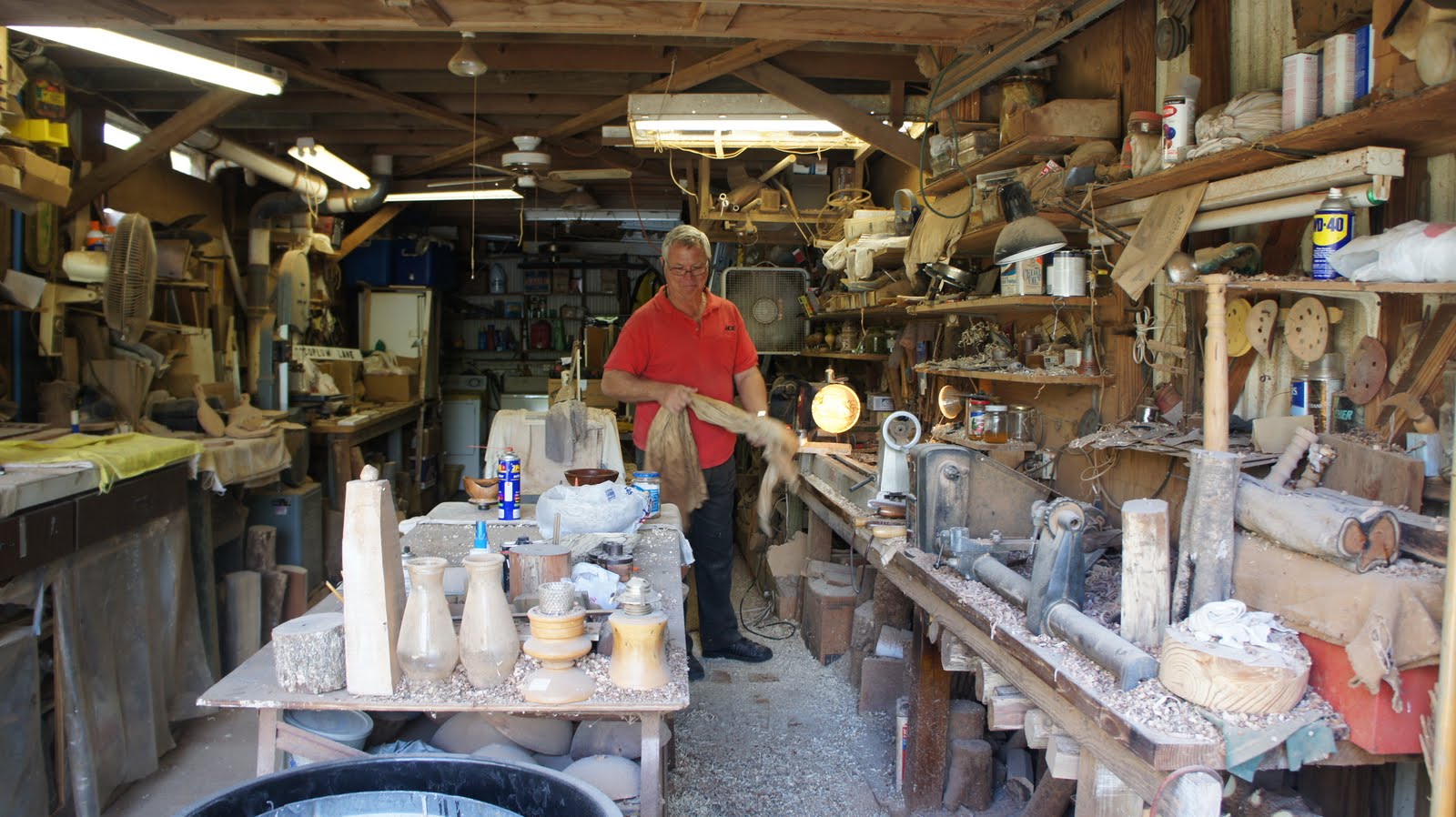
| Workshop |
| Wood stock |
| Light is focused on the bowl Steve is turning. |
| Toy top |
His workshop is filled with all kinds of equipment and tools for turning wood. Wood shavings are piled in the corners and logs are on the floor. It is a very productive and active place.
| Lantern bases |
There are examples of wood that he has turned into bowls, lanterns, trivets, and tops for children, among other things.
| Street signs |
He has a whole set of billy clubs that he has prepared for use by local fishermen, that are made out of a variety of woods. Of course, we always joke around about the many uses that we might find for such an item.
Then he showed us the trivets he was working on. We have trivets that Steve made hanging in our kitchen. They are also pretty to see on a decorated table, and are great for placing hot bowls of food.
Many of the trivets that he makes are shaped like various kinds of fish. Sometimes he adds color to their eyes to jazz them up a bit. Some trivets are beautifully plain and show off the grain of wood that he has used to make them.
The trivets can also be used as cutting boards and are very functional and look good when placed around the kitchen workspace.
We looked at a number of bowls that he made. They are all so beautiful that it is difficult to decide which one is our favorite. Here are some recent examples of his work.
| Madeira Wood 2008 |
| Fig wood 2012 |
| Tamarind Wood 2012 |
| Mahoe wood 2009 |
| Fig Wood 2012 |
Steve is also a conservationist who is concerned about native trees and protecting the local environment. When we talk, he encourages us to be knowledgeable of and to respect native trees. He emphasizes that the wood he gets is from trees that were felled by storms or branches that have fallen. Steve encourages the planting of native trees so that others will have the pleasure in the future of viewing them in the forests of Abaco and in our yards.
Steve Knowles is one of the many talented and interesting people living in the Bahama Palm Shores community, which makes it a very nice place to live as well as visit.
Subscribe to:
Posts (Atom)